
 Training players in the safety, prevention and rescue chain and developing academic partnerships
Better training for decision-makers in crisis management: safe.brussels and IHEMI combine their expertise
24.06.2026


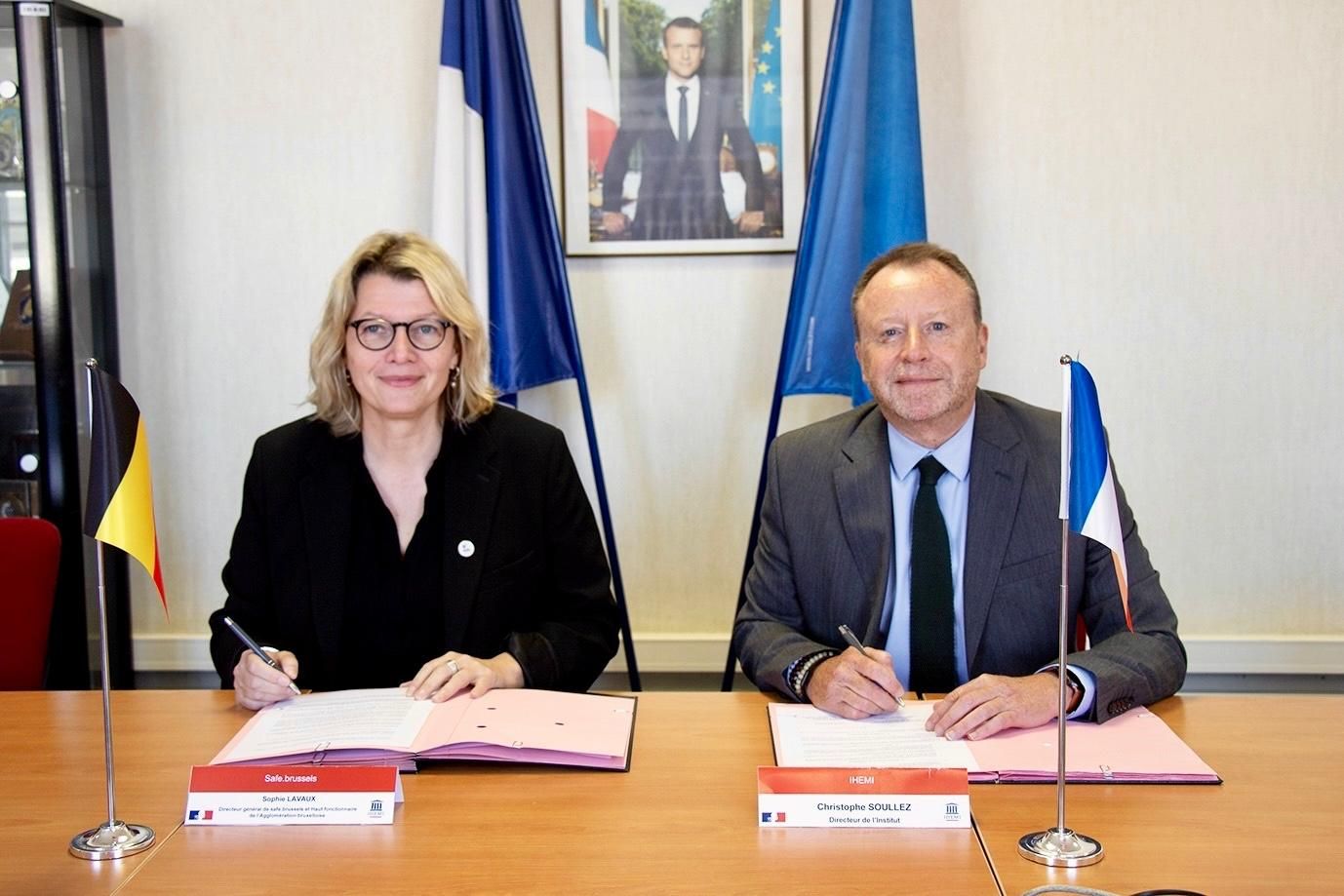
Safe.brussels and the Institut des hautes études du ministère de l’Intérieur français (IHEMI) signed a partnership agreement on Wednesday to strengthen their cooperation in the area of crisis management and communication training. This international partnership will help to ensure decision-makers and senior executives are even better prepared to deal with crises.
Sophie Lavaux, Governor for crisis management in the Brussels-Capital Region and Director general of safe.brussels: "In a crisis, you have to be able to count on your partners. This is also true for crisis management preparation and training, which are central to the missions of safe.brussels. I am therefore delighted to announce the establishment of this partnership with the IHEMI, a centre of excellence within the French Ministry of the Interior dedicated to training senior executives and providing strategic analysis for the government on issues related to internal security, justice, and crisis management. The exchange of expertise and experience among international stakeholders enables us to better prepare ourselves today, so that we can act more effectively tomorrow."
Christophe Soullez, Director of the IHEMI: "In the face of increasingly complex transnational threats, the exchange of expertise and educational innovation are our strengths, and partners are essential — both during crises and in our preparation efforts. This partnership with safe.brussels — whose integrated model aligns with our vision — is, in my view, a major step forwards, as safe.brussels' knowledge of emergency management and citizen engagement complements our expertise in training on strategic analysis and risk anticipation. Together, we provide our audience with best practices for comprehensive and flexible security."
The signing of the partnership agreement marks a new milestone in the development of relations between the two institutions. They're confirming their shared commitment to strengthening the exchange of expertise, the training of executives and decision-makers, and the sharing of best practices in the face of increasingly complex and cross-border challenges.
This cooperation should make it possible to develop a cross-cutting approach to prevention and security, while incorporating a public-private component. Specifically, the partnership covers aspects, including the development of joint training programmes, mutual participation in crisis management exercises, and the sharing of expertise and best practices in areas such as emergency planning, public awareness campaigns, the management of major events, and cooperation between public and private actors.
The partnership agreement is concluded for an initial term of five years.
Through this initiative, safe.brussels continues to develop its international cooperation strategy in order to strengthen the capacities of prevention and security stakeholders and contribute to greater resilience in the face of crises.
About the IHEMI
Located at the École Militaire in Paris and at Fort de Charenton in Maisons-Alfort, the IHEMI serves as a centre for training, reflection, and strategic planning for senior executives and high-potential professionals from the Ministry of the Interior, partner government agencies, and the private sector. There, these decision-makers develop an inter-ministerial and forward-looking vision to better grasp contemporary challenges in the areas of internal security, justice, crisis management, economic security, and local public policy. Each year, nearly 250 students enrol in its seven annual programmes, and more than 3,500 participants take its short courses. The Institute also draws on its think tank - an interdisciplinary intellectual hub - to inform public policy and contribute to the strategic planning of the Ministry of the Interior and its partners.
Similar news
 Integrating safety aspects in territorial development and the construction of public spaces
Observatory annual report
 Drugs and addiction
Notre rapport d’activités 2018 est en ligne
 Violations of integrity of the person
Lancement du Prix David Yansenne 2019
Emergency calls

Follow us!